
 English
 한국어
한국어 Tiếng Việt
 中文
中文

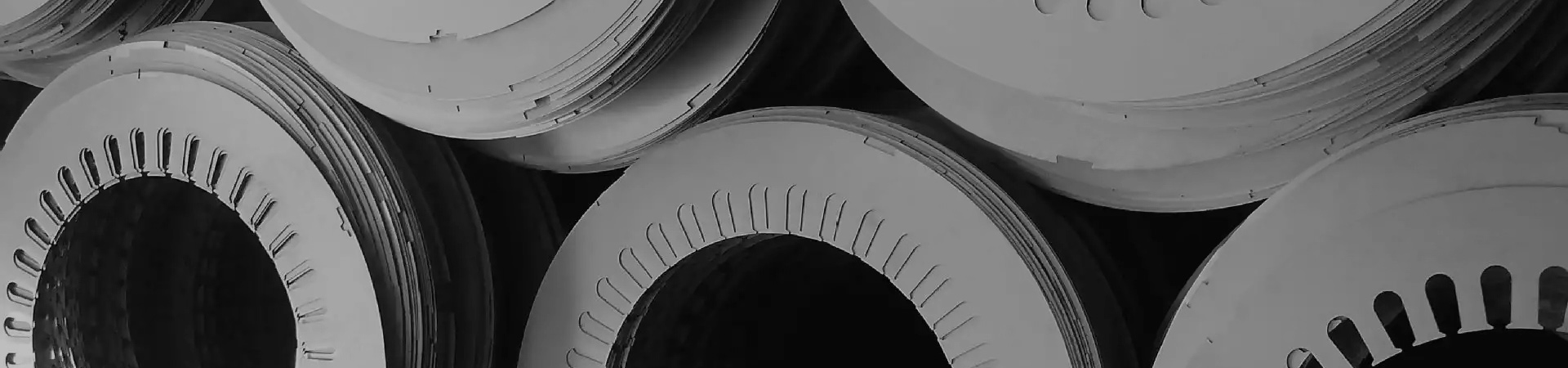
High-efficiency YVF2 motor laminations design
High-Efficiency YVF2 Motor Laminations Design The design of laminations for high-efficiency YVF2 motors plays a critical role in optimizing performance, reducing energy losses, and enhancing thermal management. Laminations are thin, stacked steel sheets that form the stator and rotor cores, minimizing eddy current losses while ensuring efficient magnetic flux distribution. Key considerations in their design include material selection, geometric optimization, and manufacturing precision. 1. Material Selection High-grade electrical steel, such as non-oriented silicon steel (NO20 or NO30), is typically used for YVF2 motor laminations due to its low core loss and high magnetic permeability. The silicon content (2-3.5%) reduces hysteresis losses, while thin gauge thickness (0.35mm or 0.5mm) minimizes eddy currents. Advanced coatings (e.g., C3 or C5 insulation) are applied to enhance interlamination resistance and prevent short-circuiting. 2. Geometric Optimization The lamination profile is designed to maximize magnetic efficiency and mechanical stability. Key features include: - Slot Design: Stator slots are optimized for winding distribution, balancing copper fill factor and magnetic saturation. Semi-closed or closed slots reduce cogging torque and improve sinusoidal flux distribution. - Pole Configuration: The number of poles (e.g., 4-pole or 6-pole) is selected based on speed and torque requirements, with careful attention to flux path continuity. - Tooth and Yoke Dimensions: Proper tooth width ensures sufficient mechanical strength while avoiding excessive magnetic saturation. The yoke thickness is calculated to maintain uniform flux density. 3. Manufacturing Precision High-precision stamping or laser cutting ensures tight tolerances (≤20µm) and smooth edges, reducing air gaps and magnetic reluctance. Stacking methods (interlocking, welding, or bonding) maintain alignment and minimize vibration. Annealing may be applied to relieve stress and improve magnetic properties. 4. Loss Reduction Techniques - Segmented Laminations: Reduces circulating currents in large motors. - Skewed Slots: Mitigates torque ripple and harmonics. - Asymmetric Designs: Improves efficiency under variable load conditions. 5. Thermal and Mechanical Considerations Laminations must withstand thermal expansion and electromagnetic forces. Ventilation ducts may be integrated to enhance cooling. In summary, YVF2 motor lamination design combines advanced materials, precision engineering, and electromagnetic optimization to achieve high efficiency, low noise, and long service life. Future trends include the use of amorphous alloys and additive manufacturing for further performance gains.
продукт
классификация:
-
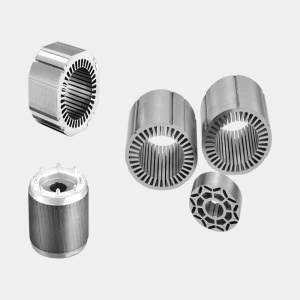
Ротор статора автомобиля на новой энергии
Их классификация: Статор и Ротормнения: 269номер:Время выпуска: 2025-10-07 08:57:44Статор и ротор двигателя транспортного средства на новой энергии: ключевые компоненты электрических силовых установокБыстрый рост индустрии транспортных средств на новой энергии (NEV) привлек значительное внимание к основным компонентам электрических силовых установок, особенно к статору и ротору двигателя. Эти компоненты играют решающую роль в преобразовании электрической энергии в механическое движение, напрямую влияя на эффективность, производительность и надежность электромобилей (EV). В этой статье рассматриваются конструкция, материалы, производственные процессы и технологические достиже...
новости
классификация:
Нет результатов поиска!
случай
классификация:
Нет результатов поиска!
видео
классификация:
Нет результатов поиска!
скачать
классификация:
Нет результатов поиска!
вербовка
классификация:
Нет результатов поиска!
Рекомендуемые продукты
Нет результатов поиска!
 Мобильный: +86 13738592999
 Телефон: +86(576) 89307999
 Электронная почта: sales@zjxinzheng.com
 Адрес: Прибрежный промышленный город, Саньмэнь.



 WhatsApp
 телефон