
 English
 한국어
한국어 Tiếng Việt
 中文
中文

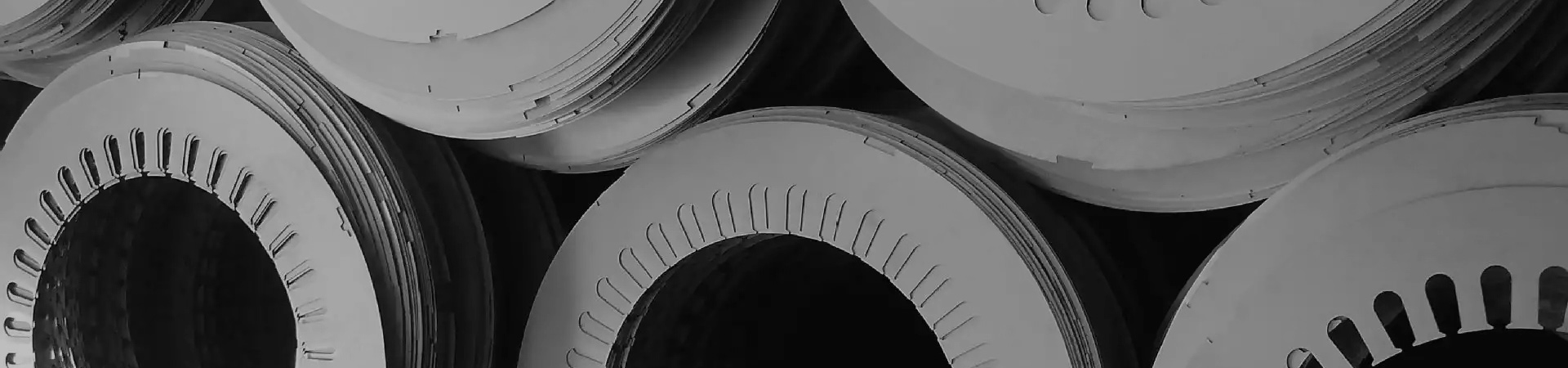
магнитная цепь сердечника двигателя
Motor Core Magnetic Circuit: Design and Functionality The motor core magnetic circuit is a fundamental component in electric motors, serving as the pathway for magnetic flux to generate torque and enable electromechanical energy conversion. It consists of laminated steel sheets or soft magnetic composites (SMCs) stacked to form the stator and rotor cores, minimizing eddy current losses while efficiently channeling magnetic fields. Structure and Materials The core is typically made of silicon steel laminations, insulated with coatings to reduce eddy currents. The laminations are punched or laser-cut into precise shapes (e.g., teeth, slots, back iron) to optimize flux distribution. For high-frequency applications, SMCs or amorphous metals may be used to further lower core losses. Magnetic Circuit Operation 1. Flux Generation: When current flows through stator windings, it creates a magnetic field that travels through the core’s low-reluctance path. The rotor core (in induction motors) or permanent magnets (in PM motors) interact with this field to produce torque. 2. Flux Path Design: The core’s geometry—such as tooth width, yoke thickness, and air gap—directly impacts magnetic saturation and flux leakage. Proper sizing ensures maximum flux linkage with minimal losses. 3. Air Gap Considerations: A small air gap between stator and rotor enhances efficiency but requires precise mechanical alignment to avoid unbalanced magnetic forces. Loss Mechanisms - Hysteresis Loss: Caused by the cyclic magnetization of core material; reduced using high-permeability, low-coercivity steels. - Eddy Current Loss: Mitigated via thin laminations or insulated layers. - Excess Losses: Result from localized flux variations, addressed through uniform material properties. Optimization Techniques - Finite Element Analysis (FEA): Simulates flux density and identifies saturation hotspots. - Topology Optimization: Adjusts core shapes (e.g., tapered teeth) to balance mechanical strength and magnetic performance. - Material Selection: Grain-oriented steels improve directional flux flow in specific motor types. Applications Magnetic circuit design varies by motor type: - Induction Motors: Focus on minimizing rotor bar losses. - Permanent Magnet Motors: Optimize flux concentration to leverage high-energy magnets. - Switched Reluctance Motors: Require segmented cores to manage highly nonlinear flux paths. Conclusion The motor core magnetic circuit is a critical determinant of efficiency, torque density, and thermal performance. Advances in materials, manufacturing (e.g., additive manufacturing for SMCs), and simulation tools continue to push the boundaries of core design, enabling lighter, more efficient motors for industries like EVs, robotics, and renewable energy systems. (Word count: 500)
продукт
классификация:
Нет результатов поиска!
новости
классификация:
-
[FAQ]Как проверить и протестировать сердечники двигателей на нали...
2025-10-07 16:31:12 -
[FAQ]Как изменения температуры влияют на производительность серде...
2025-10-08 08:57:04
случай
классификация:
Нет результатов поиска!
видео
классификация:
Нет результатов поиска!
скачать
классификация:
Нет результатов поиска!
вербовка
классификация:
Нет результатов поиска!
Рекомендуемые продукты
Нет результатов поиска!
 Мобильный: +86 13738592999
 Телефон: +86(576) 89307999
 Электронная почта: sales@zjxinzheng.com
 Адрес: Прибрежный промышленный город, Саньмэнь.



 WhatsApp
 телефон