
 English
 한국어
한국어 Tiếng Việt
 中文
中文

материалы сердечника двигателя
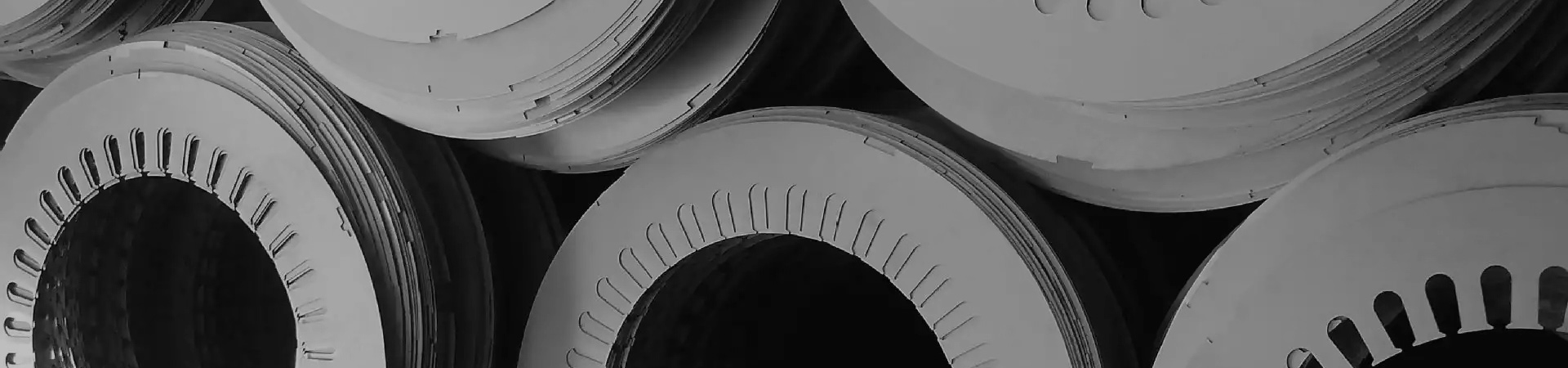
Motor Core Materials: An Overview The performance and efficiency of electric motors heavily depend on the materials used in their core construction. Motor cores, also known as stators and rotors, are critical components that influence magnetic flux, energy loss, and overall motor efficiency. The choice of core material impacts factors such as hysteresis loss, eddy current loss, saturation flux density, and mechanical strength. Below is an overview of common motor core materials and their key characteristics. 1. Electrical Steel (Silicon Steel) Electrical steel, often referred to as silicon steel, is the most widely used material for motor cores. It contains silicon (typically 1–3.5%) to improve resistivity and reduce eddy current losses. There are two main types: - Non-Grain Oriented (NGO) Steel: Used in rotating machines like motors, NGO steel has isotropic magnetic properties, meaning it performs equally well in all directions. It offers a good balance between cost and performance. - Grain-Oriented (GO) Steel: Primarily used in transformers, GO steel has superior magnetic properties in one direction but is less common in motors due to directional limitations. Key advantages of electrical steel include high magnetic permeability, low core loss, and cost-effectiveness. However, its saturation flux density (~2.0 Tesla) limits performance in high-power applications. 2. Soft Magnetic Composites (SMC) SMC materials consist of iron powder particles coated with an insulating layer (e.g., phosphate or polymer) and pressed into complex shapes. They offer several benefits: - 3D Flux Capability: Unlike laminated steel, SMC cores allow magnetic flux in three dimensions, enabling innovative motor designs. - Reduced Eddy Current Losses: The insulated particles minimize eddy currents, making SMC suitable for high-frequency applications. - Near-Net-Shape Manufacturing: SMC components can be molded into precise shapes, reducing machining and assembly costs. However, SMC materials have lower permeability and saturation flux density (~1.6 Tesla) compared to electrical steel, limiting their use in high-torque applications. 3. Amorphous Metals Amorphous metals, or metallic glasses, are produced by rapid cooling to prevent crystalline structure formation. They exhibit: - Ultra-Low Core Losses: Amorphous alloys can reduce hysteresis and eddy current losses by up to 70% compared to silicon steel. - High Resistivity: Their disordered atomic structure minimizes eddy currents, making them ideal for high-frequency motors. Despite their advantages, amorphous metals are brittle, difficult to machine, and expensive, restricting their use to specialized applications. 4. Nanocrystalline Materials Nanocrystalline alloys feature ultra-fine grain structures (typically <100 nm) and offer: - Exceptional Magnetic Properties: High permeability, low coercivity, and reduced core losses. - High Saturation Flux Density (~1.2–1.3 Tesla): Suitable for compact, high-efficiency motors. These materials are costly and primarily used in premium or high-performance applications. Conclusion The selection of motor core materials depends on application requirements, including efficiency, frequency, power density, and cost. Electrical steel remains the standard for most industrial motors, while SMC, amorphous metals, and nanocrystalline materials cater to niche applications demanding higher performance or unique geometries. Ongoing research focuses on improving material properties and manufacturing techniques to enhance motor efficiency and sustainability.
продукт
классификация:
Нет результатов поиска!
новости
классификация:
-
[Industry News]Как выбрать правильный сердечник двигателя для вашего примен...
2025-09-30 16:10:20 -
[Company News]Причины потерь в сердечнике двигателя и эффективные решения
2025-10-07 17:11:41
случай
классификация:
Нет результатов поиска!
видео
классификация:
Нет результатов поиска!
скачать
классификация:
Нет результатов поиска!
вербовка
классификация:
Нет результатов поиска!
Рекомендуемые продукты
Нет результатов поиска!
 Мобильный: +86 13738592999
 Телефон: +86(576) 89307999
 Электронная почта: sales@zjxinzheng.com
 Адрес: Прибрежный промышленный город, Саньмэнь.



 WhatsApp
 телефон